
Introduction
Matrices provide a compact way to represent and manipulate systems of linear equations, transformations, and data. In engineering mathematics, matrices are essential tools for expressing rotations, solving simultaneous equations, representing linear maps, and handling numerical algorithms.
Definition of a Matrix
A matrix is a rectangular arrangement of numbers written in rows and columns.
An m × n matrix has m rows and n columns.
Example of a 3 × 3 matrix:
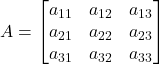
Each element is denoted by  , meaning row i, column j.
Types of Matrices
Row Matrix
A matrix with one row.

Column Matrix
A matrix with one column.

Square Matrix
A matrix with an equal number of rows and columns (n × n).
Diagonal Matrix
A square matrix where all off-diagonal elements are zero.

Scalar Matrix
A diagonal matrix with all diagonal elements equal.

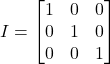
Identity Matrix
A special scalar matrix with 1 on the diagonal.
Zero (Null) Matrix
All elements are zero.

Upper and Lower Triangular Matrices
Upper triangular: elements below main diagonal are zero.
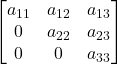
Lower triangular: elements above diagonal are zero.
Symmetric Matrix
A square matrix where  .
.
Skew-Symmetric Matrix
 , and diagonal elements are zero.
Orthogonal Matrix
A matrix whose transpose equals its inverse:

These represent pure rotations (common in aerospace dynamics).
Basic Matrix Operations
Matrix Addition
Two matrices can be added only if they have the same dimensions.
If

then

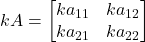
Scalar Multiplication
Multiply every entry by the scalar:
Matrix Multiplication
Matrix multiplication is defined when the number of columns of the first matrix equals the number of rows of the second.
If A is (m × n) and B is (n × p), then AB is (m × p).
Example:

Then:

Important Properties
Matrix multiplication is:
- Not commutative:
 (in general)
 - Associative:

Distributive:

Transpose of a Matrix
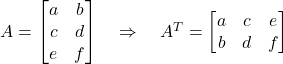
The transpose of A, written as  , is obtained by interchanging rows and columns.
Determinant of a Matrix
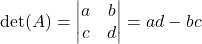
For a 2 × 2 matrix:
For a 3 × 3 matrix:
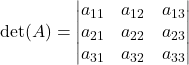
A matrix is invertible only if its determinant is non-zero.
Inverse of a Matrix
The inverse of A is denoted  and satisfies:

It exists only when  .
.
Conclusion
Matrices form the backbone of linear algebra. Understanding types of matrices and operations like addition, multiplication, transpose, and determinant lays the foundation for advanced topics such as solving systems of equations, eigenvalues, eigenvectors, and transformations—topics essential for engineering fields including aerospace.
