
Introduction
The determinant is a scalar value associated with a square matrix.
It tells us important information such as:
- Whether a matrix is invertible
- Volume scaling of linear transformations
- Whether a system of linear equations has a unique solution
- Orientation (sign) of transformation
A determinant is defined only for square matrices.
Determinant of a 2 × 2 Matrix
For a matrix

its determinant is

This is the simplest and most commonly used determinant formula.
Determinant of a 3 × 3 Matrix
Given
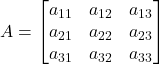
The determinant is:

Each 2 × 2 block is a minor, and the sign pattern follows cofactor expansion.
General Determinant Expansion (Cofactor Expansion)
For the i-th row:

where  is the cofactor:

and  is the determinant of the submatrix obtained by deleting row i and column j.
Elementary Properties of Determinants
1. Determinant changes sign when two rows are interchanged
If you swap any two rows:

2. If two rows (or columns) are identical → determinant is zero
This means the matrix is singular.
3. If a row or column is all zeros → determinant is zero
4. Multiplying a row by a scalar multiplies determinant by that scalar
If a row is multiplied by k:

5. Adding a multiple of one row to another row does not change the determinant
This property is used heavily in row-reduction.
6. Determinant of a triangular matrix = product of its diagonal entries
For upper/lower triangular matrices:

This is also used to quickly compute determinants during row operations.
7. Determinant of the identity matrix is 1

8. Determinant of a matrix product

This property is important in eigenvalue theory.
9. Determinant of a transpose

Geometric Interpretation
1. Area in 2D
For vectors  and
and  :
:
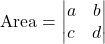
Absolute value gives the area of the parallelogram formed.
2. Volume in 3D
For vectors  ,
,  ,
,  :
:
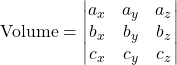
This equals the scalar triple product.
When is a Matrix Invertible?
A matrix is invertible if and only if its determinant is non-zero.

If  , the matrix:
- is singular
- does not have an inverse
- represents linearly dependent rows/columns
- leads to no unique solution in a system of equations
Determinant and System of Linear Equations (Cramer’s Rule)
For the system  , if
, if  , the solution is:

where  is obtained by replacing the i-th column of A with B.
Conclusion
Determinants are more than just computational tools — they reveal deep information about a matrix: invertibility, linear dependence, volume scaling, and geometric transformation behavior. Understanding determinant properties will make future topics like rank, eigenvalues, and linear systems much easier.
