
Introduction
A system of linear equations consists of multiple equations where each equation is linear in the unknown variables.
These systems appear everywhere in engineering: force balance, circuit equations, structural analysis, trajectory calculations, and numerical methods.
A general linear system in n variables has the form:
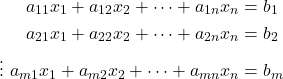
This can be written compactly as:

where:
 is the coefficient matrix
 is the column vector of unknowns
 is the column vector of constants
Matrix Form of a System
Given the system:

Matrix form:
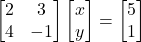
This compact representation allows us to apply systematic methods for solving the system.
Types of Solutions to a Linear System
A system can have:
1. Unique Solution
This occurs when the determinant of the coefficient matrix is non-zero:

Geometrically: lines/planes intersect at exactly one point.
2. No Solution (Inconsistent System)
Equations contradict each other.
Example:

No point satisfies both.
Occurs when:
- Rows become contradictory during elimination
- Rank conditions:
![\text{rank}(A) < \text{rank}([A|B])](https://gateing.com/wp-content/ql-cache/quicklatex.com-a027268f9acea2b6ac77962c275a6bdc_l3.png "Rendered by QuickLaTeX.com")
3. Infinitely Many Solutions
Equations are dependent.
Example:

Occurs when:
- Rows become multiples of each other
- Rank conditions:
![\text{rank}(A) = \text{rank}([A|B]) < n](https://gateing.com/wp-content/ql-cache/quicklatex.com-fa33bb4ee4297ca08f43cc475d726d83_l3.png "Rendered by QuickLaTeX.com")
Augmented Matrix
To analyze a system, we construct the augmented matrix ![[A|B]](https://gateing.com/wp-content/ql-cache/quicklatex.com-cc2f80877cb608b2b597dea9194ba2f2_l3.png "Rendered by QuickLaTeX.com") :
:
For the system:

The augmented matrix is:
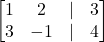
This matrix is used for row operations.
Elementary Row Operations
Three allowed operations:
- Swap two rows

Multiply a row by a non-zero constant

Add a multiple of one row to another

Row operations do not change the solution of the system.
Row Echelon Form (REF)
A matrix is in REF if:
- All non-zero rows are above zero rows
- Each leading entry (pivot) of a row is to the right of the pivot in the row above
Example REF:

Reduced Row Echelon Form (RREF)
A matrix in RREF satisfies:
- Leading entry in each row is 1
- Each leading 1 is the only non-zero entry in that column
Example RREF:

Solving Systems Using Gaussian Elimination
Example
Solve:
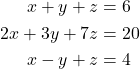
Step 1: Write augmented matrix:
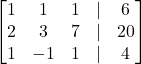
Step 2: Eliminate variables below the first pivot.
Step 3: Continue to REF and solve by back-substitution.
(If you want, I can write full worked-out steps.)
Using Matrix Inverse (Only When A is Invertible)
If  , then:

This method is practical for 2×2 or 3×3 systems but inefficient for large systems.
Cramer’s Rule (Useful for Small Systems)
For a system of n equations:

where  is the matrix formed by replacing the i-th column of A with B.
Useful for theoretical questions, not for large numerical computation.
Rank Condition for Solutions
- Unique solution:
![\text{rank}(A) = \text{rank}([A|B]) = n](https://gateing.com/wp-content/ql-cache/quicklatex.com-26f3b85835bce8fb83c5babda4605a67_l3.png "Rendered by QuickLaTeX.com")
Infinitely many solutions:
No solution:
Rank gives the most reliable test for existence and uniqueness of solutions.
Conclusion
Understanding systems of linear equations is crucial for all higher topics in linear algebra.
Methods like Gaussian elimination, rank analysis, and matrix inverses are foundational tools you will repeatedly use in engineering applications such as structural analysis, control systems, circuits, and numerical simulations.
