
Introduction
The rank of a matrix is one of the most important concepts in linear algebra.
It tells us:
- how many linearly independent rows or columns a matrix has
- how much “information” the matrix contains
- whether a system of linear equations has a unique solution, no solution, or infinitely many solutions
Rank is fundamentally connected to concepts like linear independence, invertibility, determinant, solutions of equations, and eigenvalues.
Definition of Rank
The rank of a matrix A is the maximum number of linearly independent rows or columns.
Formally:

This number is always the same whether we count rows or columns.
Rank Using Row Echelon Form (REF)
The rank is equal to the number of non-zero rows in the Row Echelon Form of a matrix.
Example:
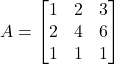
Perform row operations to convert into REF:

There are 2 non-zero rows, so:

Rank Using Reduced Row Echelon Form (RREF)
Rank is also the number of pivots (leading 1s) in RREF.
Example RREF:

There are 2 pivots → rank = 2.
Rank Using Determinants (for Square Matrices)
For an n × n square matrix:
- If
 , matrix is full rank → rank = n
 - If
 , rank < n
To find exact rank:
- Check largest minors (determinants of submatrices).
- The highest order non-zero minor gives the rank.
Example:
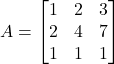
Compute 3×3 determinant:
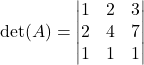
If this is zero → look at 2×2 minors.
Rank Using Linear Independence
Rank = number of linearly independent columns.
Example:
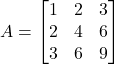
Each row is a multiple of ![[1\ 2\ 3]](https://gateing.com/wp-content/ql-cache/quicklatex.com-261fb33c9955d4e0d1ec5933a0deae44_l3.png "Rendered by QuickLaTeX.com") , so rank = 1.
, so rank = 1.
Full Rank and Deficiency
Full Row Rank
If A has m rows and:

then all rows are independent.
Full Column Rank
If A has n columns and:

then all columns are independent.
Rank Deficiency
If rank < min(m, n), matrix is rank-deficient → rows or columns are dependent.
Rank and System of Linear Equations
For a system  :
:
Unique Solution
![\text{rank}(A) = \text{rank}([A|B]) = n](https://gateing.com/wp-content/ql-cache/quicklatex.com-890e1c54c03def28ca4a12a0171e57eb_l3.png "Rendered by QuickLaTeX.com")
Infinitely Many Solutions
![\text{rank}(A) = \text{rank}([A|B]) < n](https://gateing.com/wp-content/ql-cache/quicklatex.com-b0c3141b0a4921600f32d9226791a8dd_l3.png "Rendered by QuickLaTeX.com")
No Solution
![\text{rank}(A) < \text{rank}([A|B])](https://gateing.com/wp-content/ql-cache/quicklatex.com-30672434998204d834d6f5a964a94787_l3.png "Rendered by QuickLaTeX.com")
Rank completely determines the type of solution.
Rank and Invertibility
For a square matrix A (n×n):
- If rank(A) = n → A is invertible
- If rank(A) < n → A is singular (non-invertible)
Also, eigenvalue 0 appears when rank < n.
Geometric Interpretation
Rank tells the dimension of the space spanned by the rows/columns.
Examples:
- Rank 1 matrix → all rows lie on a line
- Rank 2 matrix → rows lie in a plane
- Rank 3 matrix → rows span full 3D space
Quick Ways to Find Rank (GATE tricks)
- If a row is multiple of another → remove it
- If two rows are identical → remove duplicates
- If a row is all zeros → ignore
- Convert to triangular form → count non-zero diagonal elements
- For 2×2 matrices:
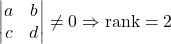
- If determinant = 0, check if one row is multiple of other → rank = 1.
Conclusion
Rank captures the essence of linear independence and determines the behavior of systems of equations, matrix invertibility, and geometric transformations. Mastering rank makes later topics like eigenvalues, diagonalization, and vector spaces much easier.
