
Introduction
The Gauss elimination and Gauss–Jordan methods are systematic procedures for solving systems of linear equations.
Both methods convert a system into a simpler equivalent form using elementary row operations, but they differ in how far the simplification goes.
- Gauss elimination reduces the matrix to Row Echelon Form (REF) and then uses back-substitution.
- Gauss–Jordan reduces the matrix all the way to Reduced Row Echelon Form (RREF), giving the solution directly.
These techniques are essential for understanding matrix rank, solution types, and numerical linear algebra.
Elementary Row Operations
These operations do not change the solution set of the system:
- Swap two rows:

Multiply a row by a non-zero constant:

Add a multiple of one row to another:

All matrix reduction methods rely on these operations.
Gauss Elimination Method (Forward Elimination)
Objective
Convert the augmented matrix into upper triangular form (REF), where all elements below the diagonal are zero.
Example system:
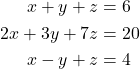
Step 1: Form Augmented Matrix
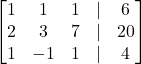
Step 2: Eliminate entries below the first pivot
Pivot = 1 (row 1, column 1).
Perform:


Result:
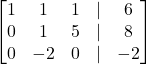
Step 3: Eliminate entries below second pivot
Pivot = 1 (row 2, column 2).

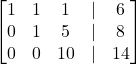
Step 4: Back-Substitution (Gauss Method)
From bottom:



Solution:

Row Echelon Form (REF)
A matrix is in REF if:
- All-zero rows are at bottom
- Each leading entry (pivot) is to the right of the pivot above it
- All entries below pivots are zero
Example:

Gauss elimination always produces REF.
Gauss–Jordan Method (Full Elimination)
Objective
Convert matrix all the way to Reduced Row Echelon Form (RREF):
- Pivots are 1
- Each pivot is the only non-zero entry in its column
- No back-substitution required
Procedure
Same steps as Gauss elimination (forward elimination), plus backward elimination.
Continuing the same example, after Gauss elimination we had:
Step 1: Make last pivot = 1

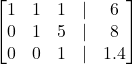
Step 2: Eliminate above the third pivot


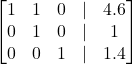
Step 3: Eliminate above the second pivot

Final RREF:
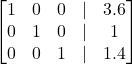
Directly giving:
Comparison: Gauss vs Gauss–Jordan
| Aspect | Gauss Elimination | Gauss–Jordan |
|---|---|---|
| Final form | REF | RREF |
| Requires back-substitution | Yes | No |
| Computation cost | Lower | Higher |
| Preferred for hand calculations | Yes | No |
| Common in numerical algorithms | Yes | Sometimes |
When to Use Which?
Use Gauss Elimination when:
- Solving systems by hand
- Only need one solution vector
- Speed is important
Use Gauss–Jordan when:
- Finding matrix inverse
- Solving multiple systems with same coefficient matrix
- Want direct solutions with no back-substitution
Key Points for GATE
- Understand pivot positions
- Know how row operations affect rank
- Identify inconsistent systems from REF/RREF
- Quickly reduce 2×2 or 3×3 systems
- Recall that Gauss–Jordan is used to compute

