
To analyze central force motion, it is convenient to express the equations of motion in polar coordinates  , since the force depends only on radial distance and points along the radius vector.
Position and Velocity in Polar Coordinates
The position vector in polar coordinates is:

The velocity vector is given by:

where:
 is the radial velocity.
 is the angular velocity.
Acceleration in Polar Coordinates
The acceleration vector is:

It has two components:
- Radial acceleration:
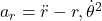
Transverse (angular) acceleration:

Newton’s Second Law for Central Force
Since the central force has no transverse component:

This yields:

So:

This equation represents conservation of angular momentum. It can be integrated to give:

where  is a constant (specific angular momentum per unit mass).
Radial Equation of Motion
The radial component of Newton’s second law is:

Substituting:

Using  , we get:
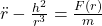
This is the radial equation of motion for central force motion.
Summary of Equations
- Conservation of angular momentum:
Radial equation of motion:
These equations fully describe the dynamics of a particle under a central force in a plane, enabling analysis of orbital trajectories and properties.
