
Introduction
Vector algebra deals with quantities that have both magnitude and direction. In engineering and physics, vectors are used to represent displacement, velocity, force, acceleration, and many other directional quantities. Understanding vector operations is fundamental for solving problems involving geometry, motion, and transformations in space.
Scalars and Vectors
Scalars
A scalar is a quantity that has only magnitude.
Examples: mass, temperature, time, density, speed.
Vectors
A vector is a quantity with both magnitude and direction.
Common notation:
- Bold letter: v
- Arrow symbol:

A vector in three-dimensional space is written as:

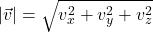
The magnitude (length) of a vector is:
Unit Vector
A unit vector has magnitude 1 and indicates direction.
To find the unit vector along (\vec{v}):

Common unit vectors along coordinate axes:

Vector Addition and Subtraction
Addition
If
and
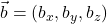
then their sum is:

Subtraction

Geometric Meaning
- Addition follows the parallelogram law.
- Subtraction gives a vector from the tip of
 to the tip of
Scalar Multiplication
Multiplying a vector by a scalar (k) changes its magnitude but not its direction (unless (k < 0)).

Dot Product (Scalar Product)
The dot product gives a scalar and measures how much two vectors are aligned.
Definition
For vectors and :

Where  is the angle between the vectors.
Component Form

Properties
- If
 , the vectors are orthogonal.
 - Dot product is commutative.
Applications
- Finding the angle between vectors
- Work done by a force:

Cross Product (Vector Product)
The cross product of two vectors gives a vector perpendicular to both.
Definition

Direction is given by the right-hand rule.
Component Form
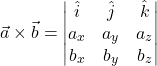
Expanded:
![\vec{a} \times \vec{b} = \begin{aligned} &+\left(a_y b_z - a_z b_y\right)\hat{i}\\[6pt] &-\left(a_x b_z - a_z b_x\right)\hat{j}\\[6pt] &+\left(a_x b_y - a_y b_x\right)\hat{k} \end{aligned}](https://gateing.com/wp-content/ql-cache/quicklatex.com-0fef48468c06b2ae3519703554e31aeb_l3.png "Rendered by QuickLaTeX.com")
Properties
- Direction is perpendicular to both vectors

- Zero if vectors are parallel
Applications
- Area of parallelogram:

Torque:

Angular momentum:

Scalar Triple Product
The scalar triple product is:

It represents the volume of the parallelepiped formed by the three vectors.
Determinant Form
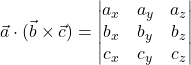
If the value is zero, the vectors are coplanar.
Vector Triple Product
The vector triple product is:

This simplifies using the identity:

It does not equal  .
.
Projection of One Vector on Another
The scalar projection of on :
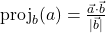
The vector projection:

Used frequently in physics for resolving forces.
Conclusion
Vector algebra forms the foundation for understanding geometry, physics, mechanics, and linear algebra. Concepts such as dot and cross products reappear throughout engineering mathematics, especially in matrix algebra, differential equations, and vector calculus.
